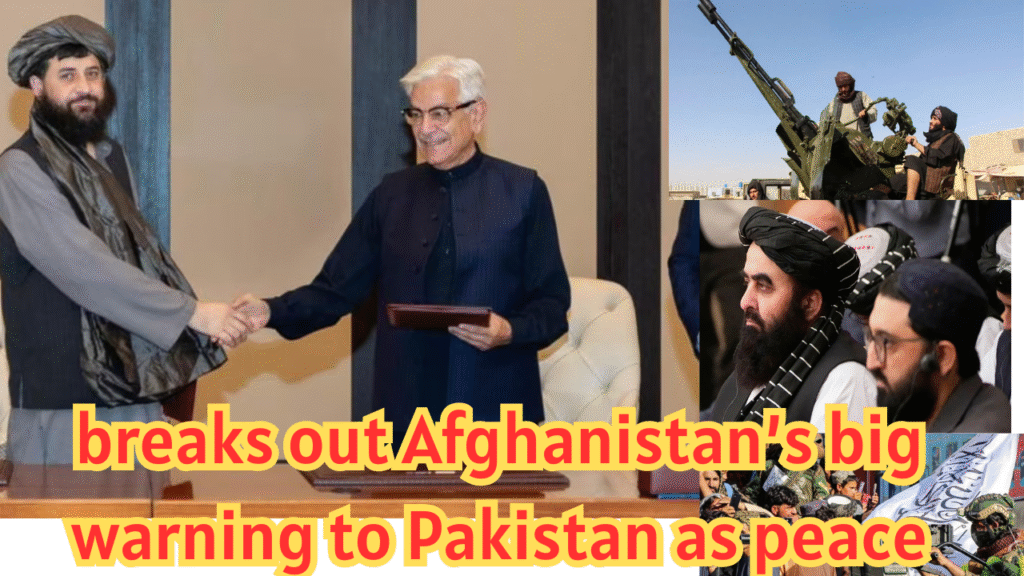

The long-standing tension between Afghanistan and Pakistan has taken on a new urgency. In recent weeks, a fresh round of peace negotiations, mediated by Istanbul, Doha and other regional players, has collapsed without agreement. In response, Kabul’s ruling government has issued a stark warning: “If war breaks out, we have the right to defend ourselves.”
This article traces the escalating diplomatic crisis, the root causes of the breakdown, what each side demands, and the potential consequences of a slide into open conflict.
Background: A fragile dialogue and a tougher border environment
The two neighbours share a long and often-disputed frontier known as the Durand Line. Historically, the border region has been a source of conflict, insurgency and mistrust. The return to power of the Taliban in Afghanistan in 2021 further changed the dynamic. Pakistan accuses Afghanistan of providing sanctuary to militants who launch attacks into Pakistani territory; Afghanistan, for its part, accuses Pakistan of violating its sovereignty through drone strikes or cross-border military action.
In October 2025 the situation escalated: civilians and soldiers were killed in border clashes, and a cease-fire was brokered by Qatar and Turkey.
The truce held only tenuously.
The failed peace talks in Istanbul
In early November, delegations from Pakistan and Afghanistan met in Istanbul under mediation by Turkey and Qatar. The goal: to turn the cease-fire into a lasting agreement, to define responsibilities regarding militant groups, and to restore trade and movement across the border.
But the talks collapsed. Afghan spokesman Zabihullah Mujahid accused Pakistan of making “unreasonable demands,” notably that Afghanistan assume full responsibility for Pakistan’s internal security
Pakistani defence minister Khawaja Muhammad Asif declared the talks over: no written agreement, no fourth round planned.
In short: both sides blamed the other, no compromise achieved, and the truce remains fragile.
Afghanistan’s warning: “If war breaks out…”
From Kabul’s perspective, the message was clear. Mujahid said: “(We) do not want insecurity in the region, and entering into war is not our first choice. If war breaks out, we have the right to defend ourselves.” Hindustan Times+1
By making this statement, Afghanistan was signalling three things:
- It rejects being forced into a subordinate role (e.g., assuming Pakistan’s security burdens).
- It emphasises its sovereignty and right to self-defence.
- It is sending a caution to Islamabad: failure of dialogue may mean escalation.
In effect, this is a rhetorical escalation — an email sent in a war of words, but one that hints at real risk.
Pakistan’s posture: Peace preferred, war as backup
On the other side, Pakistan has already made its position clear. Defence Minister Asif warned that failure in the talks could lead to “open war.” Reuters+1
Pakistan’s demands include that Afghanistan clamp down on the Tehreek‑e‑Taliban Pakistan (TTP) and other militant groups operating from Afghan soil, and that Kabul give written assurances and concrete action. The Times of India
Pakistan also emphasises the protection of its citizens and territory: “We will take necessary measures to protect our own people,” said the Pakistani information minister. Business Today
Thus, while Pakistan publicly emphasises the diplomacy channel, it keeps a clear option of military action if the situation deteriorates.
Key sticking-points in the negotiations
What exactly keeps tripping the talks up? Several issues:
- Militants & Terrorism: Pakistan wants Afghanistan to take responsibility for actions by the TTP and similar groups. Kabul resists signing up to be held accountable for Pakistan’s internal security.
- Written vs verbal commitments: Pakistan insists on a written agreement. Afghanistan offers only verbal assurances, which Pakistan finds unacceptable.
- Sovereignty & third-party action: Afghanistan objects to external strikes or drone incursions by Pakistan into Afghan territory; Pakistan insists such action is necessary to eliminate threats. The issue of Pakistan allowing “third-country” operations from its soil has also been raised.
- Border closures and trade disruptions: Pakistan has closed key crossings (like the Torkham border) and begun large-scale deportations of undocumented Afghans, creating humanitarian and economic pressure.
- Verification & monitoring mechanism: While a monitoring mechanism was proposed, how it will function, who will enforce it, and what penalty regime will apply remains contested.
These unresolved issues point to structural misalignment: each side has different priorities, red lines, and domestic constraints.
Why this matters regionally
The stakes go beyond bilateral Pakistan-Afghanistan relations. Several regional and global implications:
- Security spill-over: Instability along the Pakistan-Afghanistan border may have ripple effects in South Asia, including Pakistan’s interior, Afghan refugee flows, and militant networks.
- Trade & connectivity: Pakistan and Afghanistan share routes for trade and transit; closures hurt both economies and affect broader regional connectivity (Central Asia, China Pakistan Economic Corridor etc.). The border disruptions raise costs and reduce trust.
- Refugee/immigration pressures: Pakistan already houses millions of Afghan nationals; mass deportations and border restrictions exacerbate humanitarian stress and could destabilise border communities.
- Diplomacy & mediation credibility: With Turkey and Qatar playing mediators, a failure to deliver a peace deal could reduce faith in regional mediation frameworks.
- Great-power interests: External powers (US, China, Russia) have interests in Afghanistan and Pakistan; escalation could draw in other actors or complicate existing strategic balances.
What might happen next? Possible scenarios
Given the current impasse, several paths lay ahead.
Diplomacy resurfaces and a deal is struck
In this best-case scenario, both Pakistan and Afghanistan return to the table, broker a written understanding, set up verification and monitoring, reopen trade/border crossings, and ease tensions. Ceasefire holds, border incidents decline, and the region breathes a sigh of relief.
Continued stalemate and low-intensity clashes
A middle road: no major war, but minor skirmishes continue, border crossings remain partly closed, trade suffers, and mistrust remains. Diplomacy is on hold, but both sides avoid full-scale war for now.
Escalation into open conflict
Worst case: the warnings become reality. Pakistan mounts cross-border operations or Afghanistan retaliates; border clashes escalate into larger military confrontation; trade and transit shut down; humanitarian crisis grows; potential for regional spill-over increases. The statement “if war breaks out” may then become more than rhetoric.
Why war remains unlikely — for now
Despite the sharp words, full-fledged war between Pakistan and Afghanistan is not a foregone conclusion. Some factors mitigate risk:
- Pakistan has domestic challenges (economy, internal security) and may prefer diplomacy over full conflict.
- Afghanistan’s ruling Taliban may wish to avoid being isolated internationally and keep some relations functional.
- A war would impose heavy costs on both sides (casualties, trade losses, refugee flows, strategic isolation).
- International actors (Qatar, Turkey, maybe China and Russia) have interest in de-escalation and may exert influence.
Thus while the language is escalatory, the incentive for restraint remains.
The human and economic cost of continuing tension
This is not just a strategic game; ordinary people suffer. Border communities live in fear, cross-border trade is disrupted, refugees are stranded, economic opportunities vanish. The closure of key crossings like Torkham means trucks backed up, goods delayed, people stuck.
Further, when military operations occur, civilians die. Afghan officials reported civilians killed even during the talks.
In sum: the cost of non-peace is not just abstract, it is immediate for many.
What each side should do (and the obstacles)
For Pakistan:
- It must clarify what realistic demands it can place on Kabul, recognising Afghanistan’s own capacity constraints.
- It should open more channels for economic/trade engagement to build mutual interest in stability.
- It needs to ensure its messaging avoids provoking escalation while maintaining deterrence.
For Afghanistan:
- It should consider offering concrete, actionable steps (even if not full written commitments) to demonstrate seriousness.
- It needs to safeguard its sovereignty while cooperating on mutual security concerns.
- It must balance domestic legitimacy, especially given the Taliban’s internal dynamics, with external diplomacy.
Obstacles include mutual mistrust, domestic political pressures, non-state armed actors whose actions complicate state-to-state negotiations, and the broader strategic environment (including external actors, refugee flows, and economic fragility).
Conclusion
The title captures the moment perfectly: “If war breaks out…” is not merely a dramatic headline — for Afghanistan it is a warning, for Pakistan a contingency, and for the region a concern. The breakdown of peace talks in Istanbul reflects deeper structural issues: contested sovereignty, cross-border militancy, mismatched expectations, and economic interdependence turned into friction.
At this juncture, both Kabul and Islamabad face choices: to escalate or to stabilise. The cost of escalation could be grave — not just for them, but for the wider region. The cost of failure to see through diplomacy may be borne most by ordinary people living along that long, uneasy border.
In the end, the warning from Afghanistan is not necessarily a promise of war — but a signal that patience is not infinite. Whether Pakistan responds with greater flexibility or firmness could determine whether the next chapter is of dialogue or conflict.
Let this episode serve as a reminder: words matter, but so do actions. And when peace processes fall flat, the margin for miscalculation becomes dangerously thin.