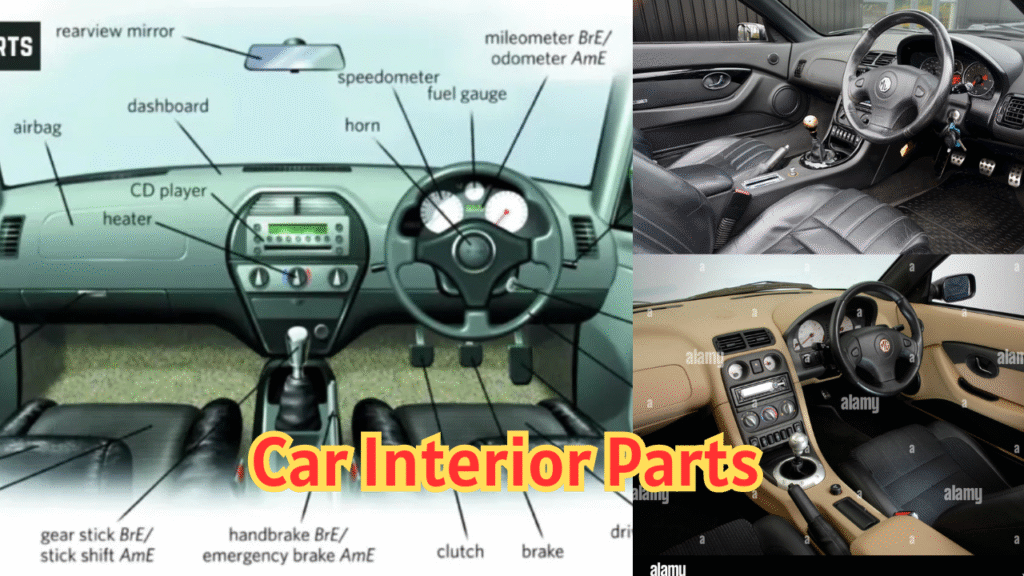

When you step inside a car, you see a combination of comfort, technology, and design — all working together to create the driving experience. But have you ever wondered what all those parts inside the car are called and what their purpose is? Whether you are a car enthusiast, a learner driver, or simply curious, knowing the car interior parts names can help you understand your vehicle better.

In this detailed guide, we’ll explore every important car interior part — from the steering wheel and dashboard to the pedals, seats, and hidden components you may not notice every day.
Dashboard Instrument Panel
The dashboard, also known as the instrument panel, is the main control area of a car’s interior. It is located directly in front of the driver and contains the essential instruments and controls.
Main Components on the Dashboard:
- Speedometer – Displays the vehicle’s speed.
- Tachometer – Shows the engine’s RPM (revolutions per minute).
- Fuel Gauge – Indicates the amount of fuel left in the tank.
- Temperature Gauge – Monitors the engine’s temperature.
- Warning Lights – Alerts for issues such as low oil pressure, seatbelt reminders, or engine malfunction.
- Odometer – Tracks total distance traveled by the car.
- Infotainment System Screen – Modern cars include touchscreen displays for navigation, music, and settings.
![20 Parts of Car Interior - [with Pictures & Names] - Engineering Learn](https://engineeringlearn.com/wp-content/uploads/2022/06/Parts-of-Car-Interior.jpg)
The dashboard also integrates air vents, airbags, and climate control switches.
Steering Wheel and Steering Column
The steering wheel allows the driver to control the direction of the vehicle. Attached to it is the steering column, which connects the wheel to the steering mechanism.
Steering Wheel Features:
- Horn Button – Usually in the center, used to alert others.
- Multifunction Buttons – Found on modern steering wheels for controlling music, phone, and cruise control.
- Paddle Shifters – In automatic cars, used for manual gear control.
- Airbag – A crucial safety feature located inside the steering wheel.
Car Seats
The seats are one of the most noticeable interior parts. They ensure comfort, safety, and support for the driver and passengers.
Types of Car Seats:
- Driver’s Seat – Adjustable for height and distance.
- Passenger Seats – Can be manually or electrically adjustable.
- Rear Seats – Designed for passengers, often with a foldable feature to increase luggage space.
- Child Safety Seat Anchors (ISOFIX) – Secure points for child car seats.
Seat materials vary from fabric and vinyl to leather, depending on the car model. Some luxury cars also feature ventilated, heated, or massaging seats.
Seat Belts
Seat belts are vital safety components. They restrain passengers during a sudden stop or collision.
Main Types:
- Three-Point Seat Belt – Common in most vehicles.
- Lap Belt – Found in older or middle seats of some cars.
- Pretensioner and Load Limiter – Modern systems that tighten the belt during impact and reduce chest injury risk.
Center Console
The center console is located between the driver and front passenger seats. It serves both a functional and storage purpose.
Common Parts of the Center Console
- Gear Lever / Gear Selector – Used to change gears in manual or automatic cars.
- Handbrake / Electronic Parking Brake – Prevents the car from rolling when parked.
- Cup Holders – To hold beverages safely.
- Armrest and Storage Compartment – For storing small items like keys or documents.
- USB Ports & Power Outlets – For charging devices.
Luxury cars often have touch controls, ambient lighting, and wireless chargers in the center console.
Pedals
The pedals are essential for controlling the car’s movement.
Pedal Types
- Accelerator Pedal (Gas Pedal) – Controls the engine’s speed.
- Brake Pedal – Slows or stops the car.
- Clutch Pedal – Present only in manual cars, helps engage or disengage gears.
In automatic cars, there are only two pedals — accelerator and brake.
Gear Shifter
The gear shifter (or gear lever) allows the driver to change gears manually or select modes in automatic cars.
Common Gear Positions (Automatic Cars)
- P (Park)
- R (Reverse)
- N (Neutral)
- D (Drive)
- S (Sport) or L (Low) for extra performance or hill driving.
In manual transmission vehicles, the driver uses the gear stick along with the clutch pedal to shift gears.
Handbrake / Parking Brake
The handbrake, also known as the emergency brake or parking brake, is used to keep the vehicle stationary when parked. It can be a manual lever, foot-operated pedal, or an electronic button.
Door Panels and Controls
Each car door contains several important parts and controls.
Typical Door Components:
- Window Controls – For opening or closing windows (manual or power).
- Door Handles – Inside and outside handles for opening the door.
- Lock/Unlock Button – Central locking feature.
- Side Mirror Controls – For adjusting external mirrors.
- Speakers – Often mounted inside the door panel.
- Storage Pockets – To keep bottles, papers, or accessories.
Premium cars also feature soft-touch door materials, ambient lighting, and memory seat buttons on the door.
Car Roof and Headliner
The roof interior is covered with a headliner, a soft fabric or vinyl layer that provides insulation and soundproofing.
Additional Roof Features:
- Sunroof / Moonroof – Transparent glass sections that can open for ventilation.
- Grab Handles – Assist passengers while getting in or out.
- Interior Lights – Dome or reading lights mounted on the ceiling.
- Sun Visors – Protect eyes from sunlight and often include vanity mirrors.
Floor and Carpet Area
The floor area of a car is covered with carpet or mats to protect the base metal and enhance comfort.
Floor Components:
- Foot Mats / Floor Mats – Removable and easy to clean.
- Dead Pedal / Footrest – Provides a resting spot for the driver’s left foot.
- Sound-Insulating Layers – Reduce road noise and vibration.
Glove Box
The glove box or glove compartment is a small storage area in front of the passenger seat. It’s used to store documents, user manuals, and small items. Many modern glove boxes feature cooling functions or lockable designs for safety.
13. Air Conditioning (AC) and Climate Control System
The AC and climate control system maintain the desired cabin temperature.
Main Parts Include:
- Air Vents – Distribute air across the cabin.
- AC Control Knobs / Digital Climate Controls – Adjust temperature and airflow.
- Cabin Air Filter – Cleans the air entering the cabin.
Some vehicles feature dual-zone or tri-zone climate control, allowing different temperature settings for each passenger area.
Infotainment System
Modern vehicles come equipped with an infotainment system, which combines entertainment, navigation, and communication.
Key Features:
- Touchscreen Display – Central interface for all multimedia functions.
- Bluetooth Connectivity – For hands-free calls and music.
- Android Auto / Apple CarPlay – Smartphone integration systems.
- Voice Commands – Allow hands-free operation.
- Navigation System – GPS maps for route guidance.
High-end systems may include premium speakers, Wi-Fi, wireless charging, and rear entertainment screens.
Interior Lighting
Lighting plays an important role in both function and style.
Types of Interior Lights:
- Dome Light – Central cabin light.
- Reading Lights – Focused lights near seats.
- Ambient Lighting – Decorative colored lights for mood and luxury.
- Footwell Lights – Small lights near the floor area.
- Trunk Light – For visibility in the luggage area.
Mirrors
Inside the car, there is one main mirror:
- Rear-View Mirror – Provides a view of the road behind.
- Manual Day/Night Mirror or Auto-Dimming Mirror options.
Some vehicles also have camera-based digital rear-view mirrors for a clearer image.
Luggage Area / Trunk (Boot Space)
Though not part of the passenger cabin, the trunk is considered part of the interior. It provides storage space for luggage, tools, and emergency kits.
Common Features:
- Carpet Lining
- Cargo Light
- Foldable Rear Seats
- Spare Tire Compartment
Interior Safety Features
Modern cars include a range of interior safety systems, such as:
- Airbags (front, side, curtain)
- Seat Belt Pretensioners
- Child Safety Locks
- Crash Sensors
- Automatic Door Locking
These parts ensure maximum passenger protection in emergencies.
19. Decorative and Comfort Elements
Besides functionality, car interiors are designed for aesthetics and comfort.
- Trim Panels (wood, chrome, carbon fiber)
- Ambient Light Strips
- Soft-Touch Plastics
- Leather Stitching
- Cup Holders and Bottle Slots
- Armrests and Headrests
Such details elevate the overall luxury and feel of a car.
Conclusion
Knowing all the car interior parts names helps you understand how your vehicle functions and what contributes to comfort, safety, and style. From the dashboard to the seats and the smallest switches, every interior component plays a crucial role in your driving experience.
Whether you’re maintaining your own car, learning about automotive design, or simply curious about what’s inside your ride, this detailed guide gives you a clear overview of every part that makes your car’s interior a perfect blend of utility and luxury.