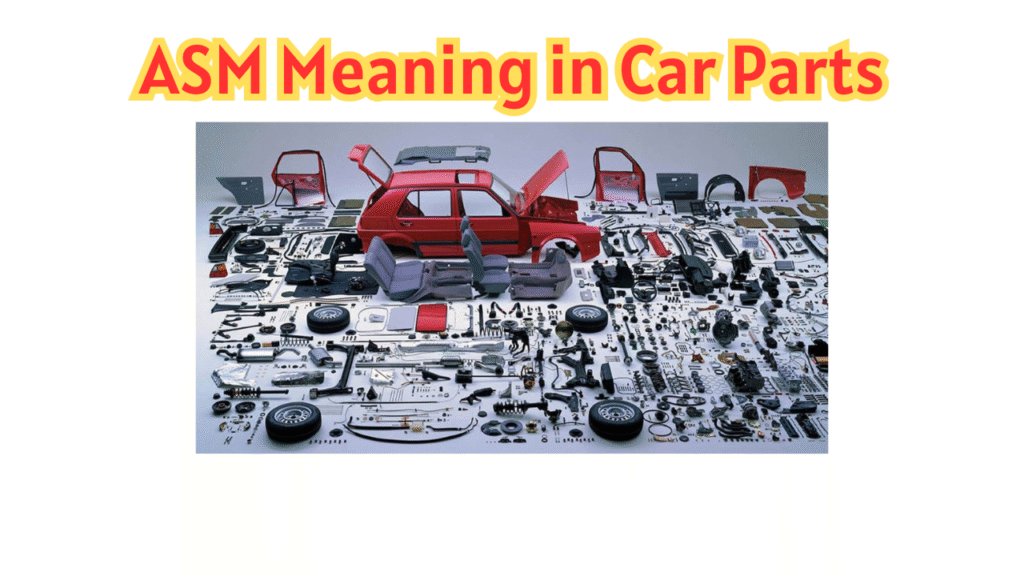

When exploring the world of car repair and maintenance, you may often come across abbreviations and short forms printed on invoices, parts catalogs, or service manuals. One of these common abbreviations is “ASM.” But what does ASM mean in car parts?
In this detailed guide, we’ll break down everything about ASM — from its full form and purpose to how it’s used in the automotive industry, what “ASM unit” means, and how it differs from individual components. Whether you’re a car owner, mechanic, or auto parts buyer, this article will give you complete clarity.
What Does ASM Mean in Car Parts?
ASM stands for “Assembly.”
In the automotive industry, “ASM” is used as a short form to refer to a collection of parts that come pre-assembled as one functional unit.
For example:
- Door ASM = The complete door assembly, including the lock, handle, window mechanism, and sometimes wiring.
- Engine ASM = The entire engine unit that includes internal components pre-installed by the manufacturer.
- Mirror ASM = A mirror assembly that includes the mirror glass, housing, and sometimes the electronic adjustment motor.
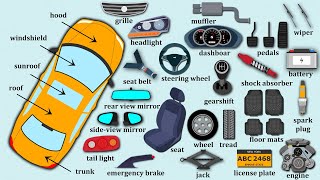
In simple terms, when a car part is labeled as ASM, it means you’re not just buying one piece but a pre-built combination of multiple parts working together.
Why Manufacturers Use ASM Parts
Manufacturers use assemblies (ASM) for convenience, safety, and efficiency.
Instead of producing and selling every small part separately, automakers provide pre-built assemblies to save time and ensure compatibility.
Main Reasons:
- Quality Control:
Assemblies are factory-tested for performance and fitment, reducing errors during repairs or replacements. - Time-Saving Installation:
It’s much faster for a technician to replace a complete door ASM than to install each part separately. - Reduced Human Error:
Pre-assembled parts ensure that everything fits and functions correctly without misalignment or faulty wiring. - Warranty and Standardization:
Assemblies come under standard warranties and meet manufacturer specifications, which ensures better reliability.

Common Examples of ASM Parts in Cars
Here are some of the most common ASM-labeled car parts you’ll encounter:
Engine ASM
- Includes: Cylinder block, pistons, crankshaft, connecting rods, oil pump, and sometimes the head assembly.
- Purpose: To provide a complete power-generating unit ready to install.
Door ASM
- Includes: Door shell, hinges, locks, handles, window regulator, and wiring harness.
- Purpose: Makes door replacement simple and fast.
Mirror ASM
- Includes: Outer shell, glass, adjustment motor, and sometimes indicators or heating elements.
- Purpose: Provides complete mirror functionality in one replacement unit.
Transmission ASM
- Includes: Gearbox casing, gears, clutch system, and sometimes the torque converter (for automatics).
- Purpose: Provides a pre-tested, ready-to-install transmission system.
Headlight ASM
- Includes: Bulbs, reflectors, housing, lens, and adjustment motor (if applicable).
- Purpose: Ensures correct beam focus and durability.
Steering Column ASM
- Includes: Steering shaft, joints, column switches, and wiring.
- Purpose: Simplifies the replacement of steering components with a tested, integrated unit.
Suspension ASM
- Includes: Struts, springs, mounts, and bearings.
- Purpose: Provides factory-tuned performance and safety.
Difference Between ASM and Component Parts
Understanding the difference between ASM and individual parts is important when ordering or repairing.
| Aspect | ASM (Assembly) | Individual Component |
|---|---|---|
| Definition | Pre-assembled unit with multiple parts | Single, standalone piece |
| Example | Door ASM includes locks, glass, handle | Door handle alone |
| Installation | Quick and simple | Requires manual fitting and alignment |
| Cost | More expensive | Cheaper individually |
| Reliability | Factory-tested and guaranteed | Depends on assembly quality |
| Use Case | Major replacements | Minor repairs |

So, while buying a full ASM may seem costly, it often saves time, labor, and future maintenance costs.
How to Identify ASM Parts in Car Catalogs
When you look at a car parts catalog or repair manual, you’ll often notice part names followed by “ASM” — this indicates an assembly part.
For instance:
- “Fuel Pump ASM” = Complete fuel pump unit.
- “Radiator Fan ASM” = Fan motor, blades, and shroud in one.
- “Seat ASM” = Entire seat structure with cushions and wiring.
Tips for Identification:
- Look for “ASM” or “ASSY” suffixes — both mean assembly.
- If the part has multiple subcomponents listed, it’s likely an ASM.
- OEM catalogs usually have an exploded diagram showing what’s inside the ASM.
OEM vs Aftermarket ASM Parts
There are two main sources for ASM car parts:
OEM (Original Equipment Manufacturer) and Aftermarket brands.
OEM ASM Parts
- Made by the original car manufacturer (like Toyota, Ford, or Honda).
- Perfect fit and factory-tested.
- Usually more expensive but come with a warranty.
- Ideal for critical parts like engine or transmission ASM.
Aftermarket ASM Parts
- Made by third-party manufacturers.
- More affordable but quality can vary.
- Good for non-critical parts like mirrors, lights, or bumpers.
- May not have the same lifespan as OEM assemblies.
Tip: Always verify compatibility by part number before purchasing an ASM replacement.
Advantages of Using ASM Parts
Here are the key benefits of choosing assembly parts over individual components:
- Ease of Replacement:
Installations are faster since everything is already pre-fitted. - Enhanced Reliability:
Factory-built assemblies have consistent quality and testing. - Reduced Downtime:
Service time at garages is shorter, saving on labor costs. - Guaranteed Compatibility:
All parts inside an ASM unit fit perfectly with each other. - Safety Assurance:
Critical systems like brakes, steering, and engine assemblies ensure proper performance and reduced risk of malfunction.
Disadvantages of ASM Parts
While ASM parts have many benefits, there are also some downsides:
- Higher Initial Cost:
Buying the entire assembly costs more than a single component. - Limited Repair Flexibility:
If only one small part fails, you still might need to replace the whole assembly. - Availability Issues:
Some older car models may have limited ASM replacements. - Environmental Concerns:
Replacing full assemblies instead of single parts can generate more waste.
Real-Life Example: Mirror ASM
To understand it better, let’s take an example of a side mirror ASM.
When you purchase a mirror ASM, you get:
- Mirror glass
- Housing shell
- Electronic adjustment motor
- Indicator light (in some models)
- Wiring harness
If your mirror glass breaks, technically you could replace just the glass.
But if your electric adjustment stops working, buying a full Mirror ASM ensures every function is restored — saving time and avoiding mismatch issues.
ASM in Electric and Hybrid Vehicles
In modern electric or hybrid cars, assemblies have become even more common.
For instance:
- Battery Pack ASM = Battery cells + cooling system + sensors.
- Motor Controller ASM = Power inverter + wiring harness + control module.
- Charging Port ASM = Socket, cover, and cable pre-installed.
Electric vehicles rely heavily on integrated assemblies to maintain safety and performance standards, as improper assembly can lead to system failures or even fire hazards.
How Mechanics Handle ASM Parts During Repairs
When a mechanic diagnoses a fault, they often prefer replacing a full assembly rather than repairing it piece by piece — especially if it’s time-consuming or unsafe to rebuild.
For example:
- Instead of rebuilding a damaged steering column, they replace the Steering Column ASM.
- If a transmission fails, a Transmission ASM is installed instead of repairing gears individually.
This approach ensures faster service, guaranteed performance, and long-term reliability.
Cost Comparison: ASM vs. Individual Parts
Here’s a quick comparison example:
| Part Type | Individual Component Cost | ASM Cost | Total Installed Cost | Notes |
|---|---|---|---|---|
| Mirror Glass | $25 | $150 | $200 (installed) | ASM includes motor, cover, and wiring |
| Door Handle | $30 | $400 | $450 | Door ASM includes lock, hinges, and electronics |
| Fuel Pump Motor | $80 | $250 | $300 | ASM includes housing and filter |
While ASM prices are higher, installation labor and performance reliability often make them a smarter long-term investment.
How to Choose the Right ASM for Your Vehicle
Before purchasing or installing an ASM part, keep these steps in mind:
- Check the VIN (Vehicle Identification Number):
Use your VIN to match the exact ASM specification. - Consult the Manufacturer Catalog:
OEM websites provide detailed part numbers and compatibility charts. - Verify Warranty Terms:
Ensure your ASM comes with a valid warranty and return policy. - Buy from Trusted Sellers:
Avoid cheap duplicates — they may not meet safety standards. - Ask Your Mechanic:
Certified mechanics can confirm whether an ASM replacement is necessary or if a smaller repair would suffice.
The Future of ASM in Automotive Engineering
As cars become more advanced, especially with automation, sensors, and electrification, ASM usage will continue to grow.
Manufacturers are moving toward “modular assembly systems” where entire modules — such as front fascia ASM, dashboard ASM, or even electronic control ASM — are swapped out instead of repaired.
This approach reduces service time, simplifies production, and ensures consistent safety standards across all vehicles.
Conclusion
The term ASM (Assembly) in car parts represents the growing sophistication and modular design of modern vehicles. Instead of dealing with hundreds of small, complex parts, automakers and repair technicians now rely on pre-assembled, factory-tested units for convenience, quality, and safety.
From engines and doors to mirrors and electronics, ASM parts simplify repairs and ensure lasting reliability — even though they might cost more upfront.
So next time you see a label like “Mirror ASM” or “Engine ASM”, you’ll know it refers to a complete, ready-to-install unit that saves time, ensures compatibility, and maintains your car’s original performance standards.